
Solar Co-location
Solar and BESS assets have complimentary dispatch profiles which make them perfect for co-location
A co-located site has both a battery and another asset (generation, or demand) connected to the grid using the same connection.
Check out the Modo Energy platform for more info:
https://modoenergy.com/research/
What is it?
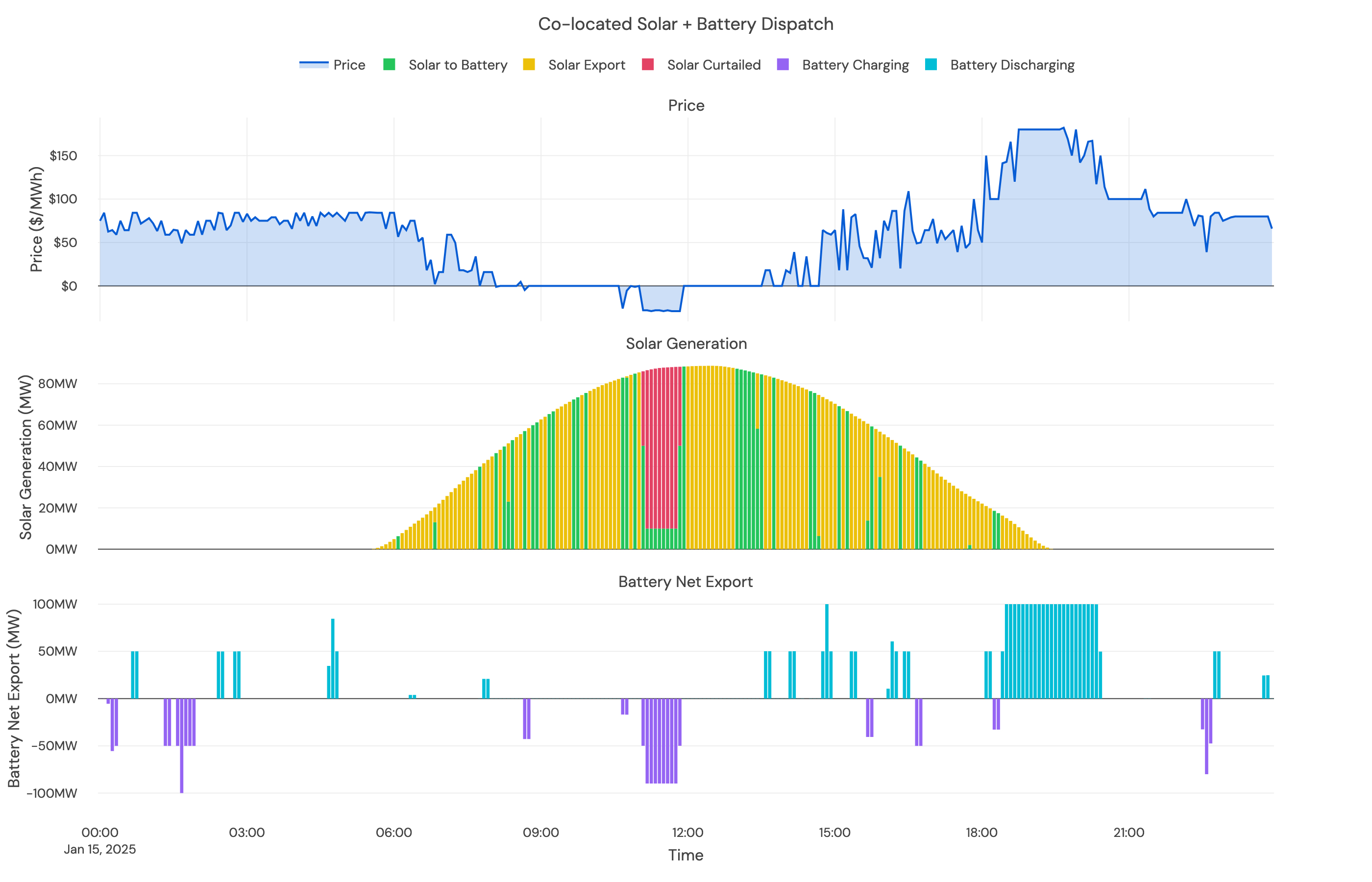
The co-location feature models battery and solar assets operating at the same site. The dispatch model optimises whether solar generation should export directly to the grid or charge the battery, maximising total site revenue.
How do we model it?
The model determines the most profitable strategy for each 5-minute interval:
- Direct Solar Export: Sell solar immediately at spot price + earn LGC credits
- Solar-to-Battery: Store solar energy for later sale during higher prices + earn LGC credits (adjusted for inverter losses)
- Battery Arbitrage: Standard charge/discharge to capture price spreads
- Curtailment: Reduce solar generation when revenues are negative or grid limits are reached
Where do the solar traces come from?
Solar profiles are generated from the ERA-5 climate database based on a 2023 weather year (consistent with the fundamentals model). This uses the following key inputs:
- Co-ordinates
- Azimuth
- Tilt
- Tracking type (SAT or Fixed)
AC vs DC Coupled sites
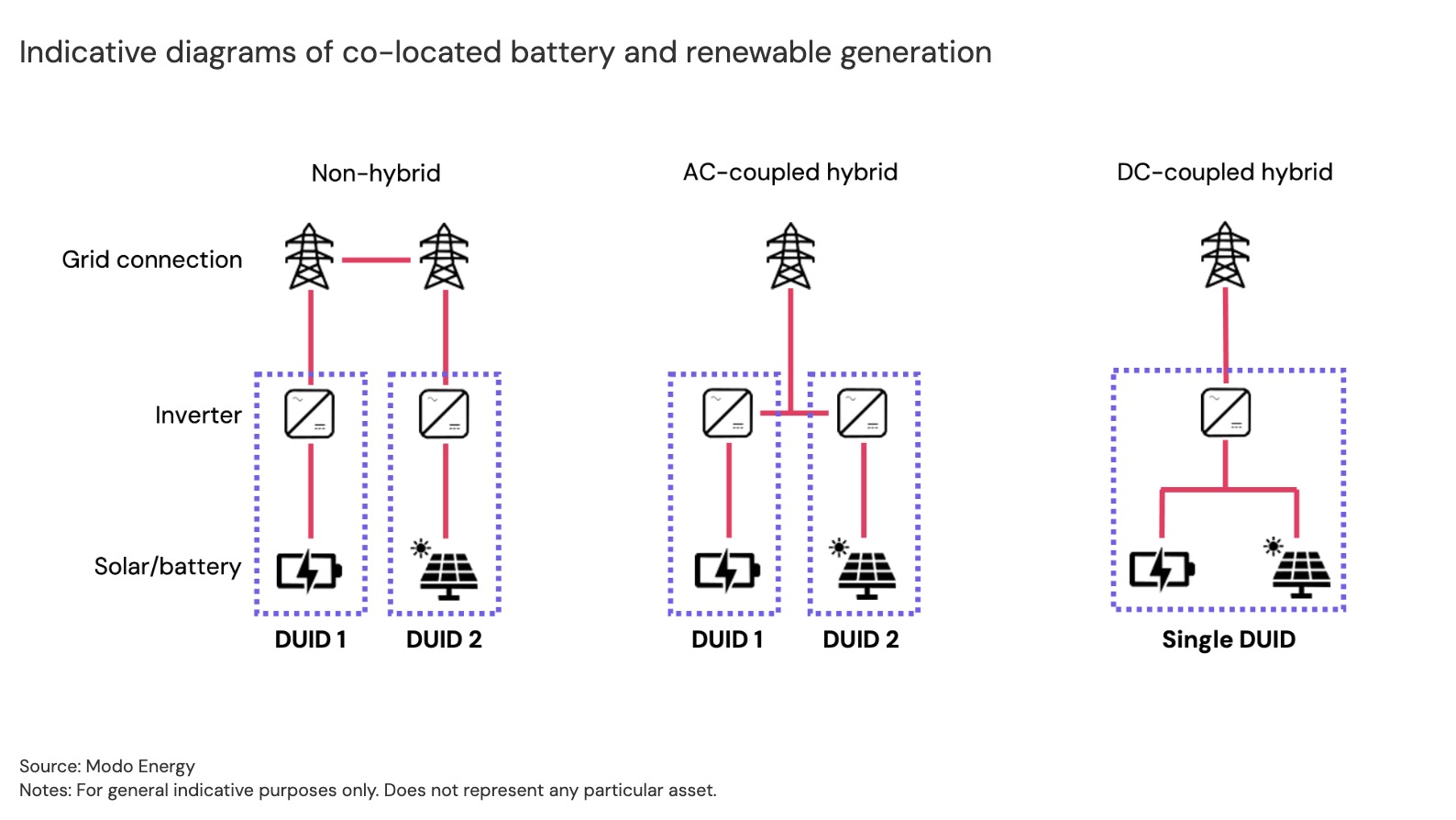
This optimisation changes depending on whether the solar and BESS connection is behind (DC-Coupled) or in front of (AC-Coupled) the inverter.
Most notably:
- AC-Coupled sites are required by AEMO to register as two separate DUIDs with sub-meters. This means that the solar is not able to directly charge the battery. The solar would have to sell into the energy market whilst the battery simultaneously charges from the energy market.
- DC-Coupled sites can be co-optimised in that the solar can charge the battery directly behind the same inverter, and dispatch as a single DUID.
Updated 10 months ago